

If you are setting up a metal fabrication line, one of the first decisions you will face is: should I use a roll forming machine or a press brake?
Both processes shape metal, but they serve completely different purposes. Choosing the wrong one can cost you time, money, and lost opportunities.
Here is a clear comparison to help you decide.
What Is Roll Forming?
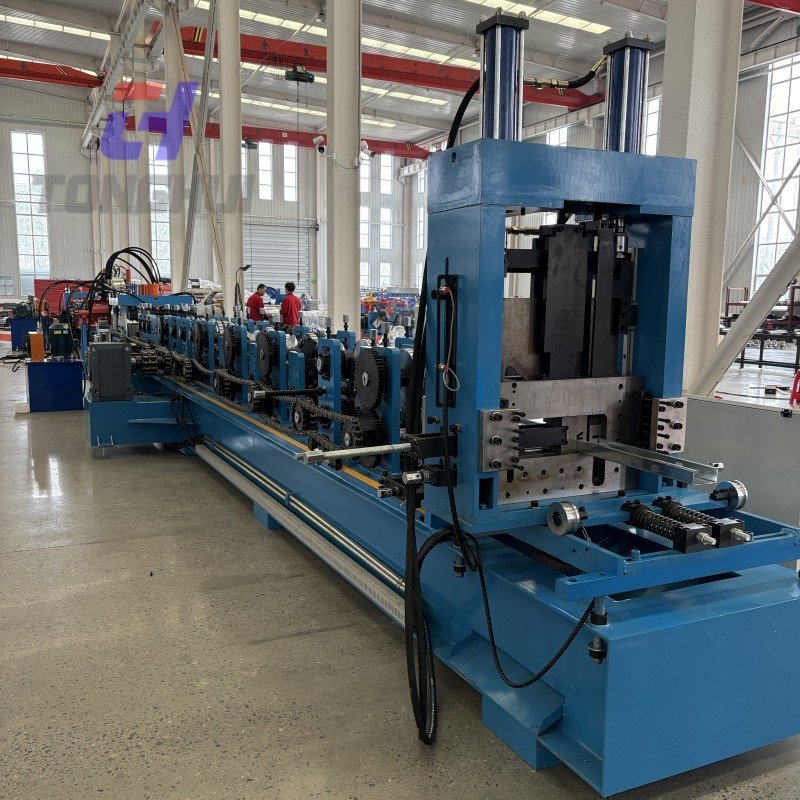
Roll forming is a continuous bending process where a metal sheet passes through a series of rollers. Each roller station gradually bends the material until it reaches the final profile shape.
Roll forming is ideal for:
- Long, continuous parts
- High-volume production
- Consistent cross-section profiles
- Running the same profile for months or years
Common products: Roof panels, C purlins, Z purlins, standing seam panels, guardrails, decking sheets.
What Is a Press Brake?
A press brake is a machine that bends sheet metal using a punch and die. It performs a single bend (or a series of bends) on a flat sheet in a step-by-step process.
Press brakes are ideal for:
- Short runs or prototypes
- Parts with multiple or non-uniform bends
- Frequent design changes
- Custom one-off components
Common products: Brackets, enclosures, custom metal parts, small batches of bent components.
Key Differences at a Glance
| Factor | Roll Forming Machine | Press Brake |
|---|---|---|
| Production Volume | Very high – runs of tens of thousands to millions of feet | Low to medium – single prototypes to thousands of units |
| Unit Cost | Extremely low at scale | Medium to high – each part takes similar labor |
| Tooling Cost | High – custom roller dies require significant upfront investment | Low – standard punches and dies are affordable |
| Production Speed | 30–100+ meters per minute | Much slower – stop-and-go process |
| Process Flexibility | Very low – profile changes require teardown and reconfiguration | Very high – new part can be set up in minutes |
| Part Length | Essentially unlimited – only limited by coil length | Limited – typically under 6 meters |
| Cross-Section | Consistent profile for full length | Can include multiple bends and complex geometry |
| Labor Cost | Minimal – automated lines require little operator attention | High – requires skilled operator for each part |
When to Choose Roll Forming
Choose roll forming when you need:
- High-volume production of parts with the same cross-section
- The lowest possible unit cost
- Long parts that a press brake cannot handle
- Consistent quality across millions of parts
Roll forming is the only practical choice for long continuous components like purlins, tracks, and roofing panels.
When to Choose a Press Brake
Choose a press brake when you need:
- Prototypes or low-volume production
- Parts with varying or complex bend sequences
- Frequent design changes
- Quick turnaround without heavy tooling investment
Press brakes dominate high-mix, low-volume manufacturing.
The Business Math
Roll forming requires a higher upfront investment in tooling, but the per-part cost drops dramatically at scale. Press brakes have low entry cost but higher per-part labor costs.
For production runs under 5,000 units, a press brake is usually more cost-effective. For runs above 50,000 units, roll forming becomes significantly cheaper per part.
Many manufacturers actually use both: a press brake for prototypes and custom work, and a roll forming line for high-volume production.
Still Not Sure Which One You Need?
Send us your profile drawing and estimated annual volume. We will recommend the most cost-effective solution for your specific application.
Contact Tonghui Machinery today for expert advice.