

Global Steel Structure Industry Trend Analysis (2025-2030)
1. Global Steel Structure Industry Enters a High-Speed Development Cycle
Subtitle: Accelerated Industrialization Pace | Prefabricated Construction Drives Demand Growth
Over the past five years, the global steel structure industry has maintained steady growth. Entering 2025, with the ongoing upgrades of industrial plants, expansion of logistics and warehousing, and continuous advancement of photovoltaic (PV) support system construction, the application scenarios for steel structures continue to expand.
According to industry forecasts, the average annual growth rate of the global steel structure market from 2025 to 2030 is expected to remain between 4.5% and 6.2%, with a significant increase in the demand for structural components.
The primary global growth drivers stem from three major sectors:
- Industrial Plants & Warehousing Logistics: Rapid construction of cross-border e-commerce and automated warehouses makes steel structure plants the preferred solution.
- PV & New Energy Support Systems: Widespread use of C/Z/U-shaped cold-formed components in PV mounts drives substantial demand for forming equipment.
- Prefabricated Buildings: Increasing adoption rates in Europe, the US, the Middle East, and Southeast Asia lead to a sharp rise in the use of standardized steel structures.
2. Steel Structure Material Upgrade: High-Strength Steel & Galvanized Materials Become Mainstream
Subtitle: High-Strength Trend is Evident | Stricter Requirements for Forming Equipment
In terms of material trends, the industry is gradually transitioning from Q235 to Q355 and Q420, with 550MPa high-strength steel even becoming common in the PV sector.
This material upgrade brings three major industry changes:
- Higher tensile strength demands stricter roll forming precision.
- Higher requirements for roller material and heat treatment processes.
- Machine structures need to be more stable, torsion-resistant, and adaptable to long-term loads.
Consequently, more EPC and steel structure companies globally are inclined to purchase C Purlin/C-Z Purlin forming equipment characterized by high rigidity, heavy-duty structure, and high-precision CNC rollers.
3. Cold Forming Equipment Automation Enters a ‘Deep-Water Zone’
Subtitle: Intelligent Upgrades | Labor Saving | Enhanced Production Efficiency
The rapid development of the steel structure industry has propelled cold forming equipment into a comprehensive automation upgrade phase. Current global equipment upgrades are mainly manifested as:
- Auto-Changeover Technology Becomes Standard Trend: C-Z Purlin production is gradually phasing out traditional manual changeover methods. Automatic changeover equipment can complete C-to-Z profile switching within 3-5 minutes, making it highly favored by overseas steel structure enterprises.
- Punching Systems Evolve from Manual to Full Servo Positioning: New trends include automatic multi-position switching, servo positioning punching, hole pattern database management, and synchronization with production plans.
- Increased Penetration of Digital Control Systems: PLC + Touchscreen is now standard; the industry is moving towards data acquisition + quality monitoring + automatic error reporting + remote diagnostics.
- Intelligent Stacking & Automatic Packaging Gain Popularity: Large C Purlin producers are increasingly adopting automatic stacking to replace manual labor, improving efficiency and reducing labor costs.
4. PV Mounting Industry Becomes the Fastest-Growing Sector for C & Z Purlin Demand
Subtitle: Global Energy Transition | Explosive Demand for Steel Structures in Mounting Systems
PV power plant construction continues to grow, with global annual installed capacity expected to increase by 10%-15% from 2025-2030. The most commonly used cold-formed components in PV mounting systems include:
- C Purlin
- Z Purlin
- U Channel
- Rail profiles
- Bracing, supports, connectors
Among these, C Purlin forming equipment and PV mounting system roll forming production lines have become one of the best-selling types of cold forming equipment recently.
Core requirements for equipment in PV projects include:
- High forming precision
- Stable adaptability to high-strength steel
- Burr-free cutting
- Length tolerance within 0.5mm
- Suitability for continuous, long-term operation
Therefore, the demand for high-end C Purlin production lines continues to rise globally.
5. Global Steel Structure Market Presents New Export Opportunities for Cold Forming Equipment
Subtitle: Strong Demand in Emerging Markets | Enhanced Competitiveness of Chinese Equipment
With the standardization of building structures and the popularization of steel structures, the global cold forming equipment market is facing historic opportunities.
Regions currently experiencing booming demand include:
- Middle East (Saudi Arabia, UAE, Qatar): Numerous new energy and industrial construction projects.
- Southeast Asia (Vietnam, Indonesia): Rapid growth in foreign-invested factories and construction demand.
- South America (Peru, Chile): Large-scale construction of PV mounts and warehousing plants.
- Europe (Germany, Poland, Netherlands): Higher demand for automation and intelligent equipment.
Chinese cold forming equipment, leveraging improved quality, strong customization capability, fast delivery, and high cost-effectiveness, is rapidly gaining market share worldwide.
6. Industry Trend Forecast for the Next Five Years (2025-2030)
Subtitle: Intelligence | Standardization | Green Production
The steel structure industry is expected to exhibit the following five major trends:
- Trend 1: High-strength steel becomes the mainstream material. Equipment must support stable forming of materials ≥550MPa.
- Trend 2: Automatic changeover and full servo control become standard. Demand for C-Z automatic changeover production lines will continue to increase.
- Trend 3: Intelligent detection and automatic adjustment become industry standards. Examples: online measurement, automatic calibration of forming gaps.
- Trend 4: Green production and low-noise technology become key procurement factors. Rising environmental demands require more energy-efficient and quieter equipment.
- Trend 5: Product standardization drives batch procurement of equipment. Multinational EPC and large steel structure enterprises will procure forming production lines in batches.
7. Opportunities and Challenges for Cold Forming Equipment Enterprises
Subtitle: Who Will Win the Global Market?
Opportunities
- Continued growth in PV mounting and steel structure plants.
- Emerging markets require large amounts of equipment.
- Automation upgrades create profit margins for high-end equipment.
- Digital control enhances differentiated competitiveness.
Challenges
- Increased difficulty in forming high-strength steels.
- Stricter international certification requirements (CE/UL).
- Increased R&D investment for intelligent systems.
- Intensifying global competition (especially from manufacturers in India, Turkey).
Conclusion:
The next five years represent the optimal window for the high-end, intelligent, and global development of the cold forming industry. Those who master “precision forming + automation control + digital inspection” will become key suppliers in the global steel structure industry chain.
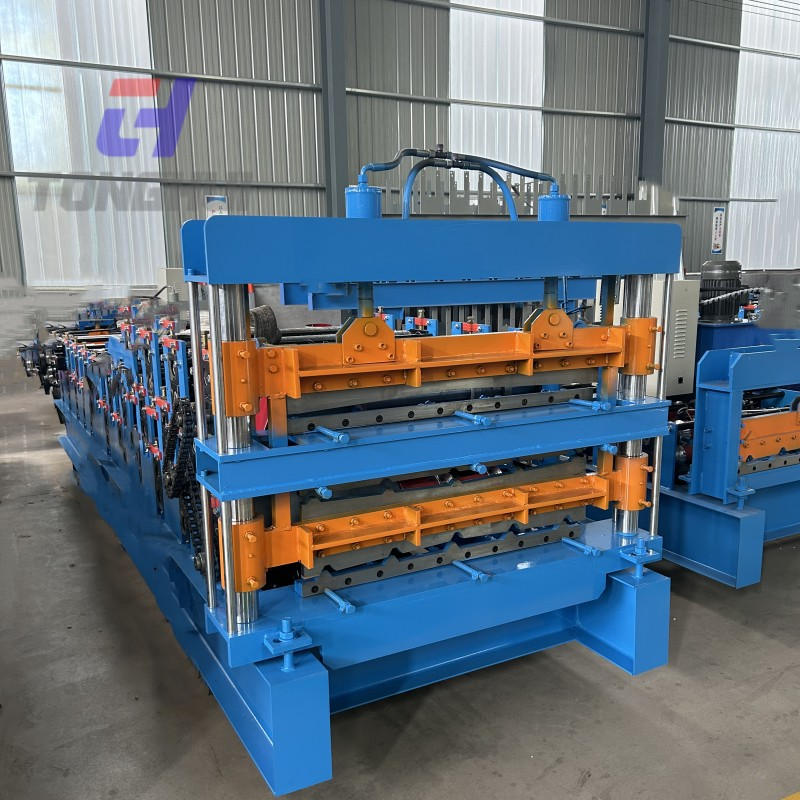
Our single and double layer roll forming machines are widely used in warehouse, factory and steel structure projects in Saudi Arabia, UAE, Kuwait and other Middle East countries.
Our machines can produce trapezoidal roof panels and corrugated sheets, with stable performance and 2‑year warranty.
We are a professional Chinese manufacturer, providing factory direct price and reliable after‑sales service.